How often do your agents say they finished when they didn’t?
Two ways to find out. Both run on your side — nothing is uploaded unless you explicitly ask, and you see exactly what would go before it does.
Drop a log in your browser
Everything happens client-side. The file never touches a network — that’s a property of the code, not a promise in a privacy policy.
Drop a session log here
from ~/.claude/projects/ — or click to choose
processed in this browser · never uploaded · no account
Set it up
npx gitreal setup
It tells you exactly what it is about to change — one Stop hook in your settings file, backed up first — and asks before it writes anything. Then it runs itself against your most recent session to prove it works, and opens the dashboard. Warn mode: it reports, it stops nothing.
Restart Claude Code afterwards. Hooks are read at startup, so nothing happens until you do. When you have watched it for a day and it looks right, npx gitreal setup --block lets it stop turns, and npx gitreal uninstall takes it all back out.
Install it as a plugin
No terminal, no npm. Two slash commands, and Claude Code asks for confirmation before it adds anything.
/plugin marketplace add thepatchman/doubtit-landing-page
/plugin install gitreal@gitreal
Same gate, same code — the plugin bundles the identical script the npm package installs. It reports by default; set GITREAL_BLOCK=1 in your environment to make it enforce.
Or scan all your sessions
npx gitreal
Finds your logs itself, analyses every session, and prints a report. Nothing is uploaded.
npx gitreal setup            set it up, ask first, open the dashboard
npx gitreal setup --block    same, but let it stop unverified turns
npx gitreal                  local audit, nothing uploaded
npx gitreal --json out.json  full result to a file
npx gitreal --logs <dir>     scan a specific directory
npx gitreal watch            just the dashboard, no install
npx gitreal doctor           check it is actually working
npx gitreal uninstall        remove it
npx gitreal --share          contribute runs with known outcomes
npx gitreal --mcp            run as an MCP server
One tile per turn, thumb up or thumb down
npx gitreal watch
Opens a small page on 127.0.0.1 that you park next to your editor. Every turn your agent takes lands as a tile: thumb up if it changed something and something checked it afterwards, thumb down if it changed something and nothing did, a dash if it only talked. You can see a run go quiet-but-busy in real time instead of finding out later.
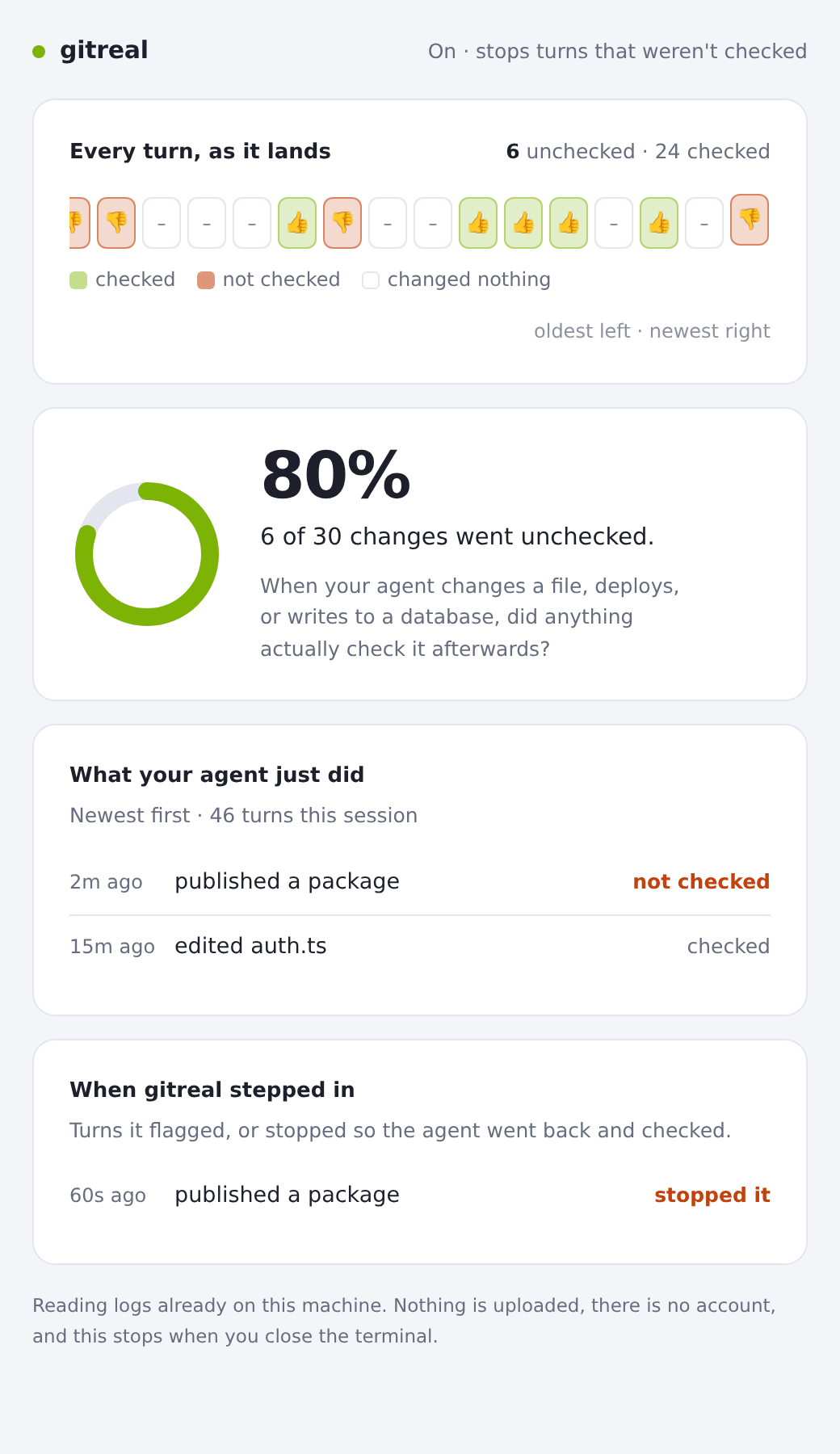
It reads the transcripts already on your disk through the same code path as the gate, so the page and the gate can never disagree. Bound to loopback, no account, nothing uploaded, and it stops when you close the terminal.
Let it notice, before it tells you it's done
One line in an agent’s config, and it can look at its own run before making a claim about it.
{ "mcpServers": {
    "gitreal": { "command": "npx", "args": ["gitreal", "--mcp"] }
} }
Exposes one tool, check_my_work. It returns observations — changes never read back, a run that ended on a write — and no score. There is no score anywhere in this project; we built one, measured it below chance, and removed it.
An agent checking itself is self-attestation, so the response is stamped attestation: self_attested and satisfies_policy: false. Under the spec that can never clear a requirement — an agent reporting on its own work has produced a second claim, not evidence. The point of the tool is to make an agent notice an unverified change while it can still go and check it for real.
Your next message is the ground truth
There is no oracle in production. But you react — and the reaction is in the log. If an agent said it was done and the next thing you typed was “still broken” or “try again”, that run failed and the agent didn’t know.
The first version matched keywords anywhere in your next message — including inside pasted logs. A hand audit of six judgements found two correct: one run marked failed on the word “error” that appeared in a paste, another marked successful because “awesome” turned up in a list of domain prices. It now reads only what you typed, only the opening of your reply, and returns unknown when unsure — three of three, judging half as many. It will still be wrong sometimes, and it says nothing rather than guessing.
Redaction isn't optional
Agent logs are full of credentials. Redaction runs before anything is displayed and before anything is sent — provider tokens, credentials in URLs, assignment patterns, JWTs, private keys, emails. It is deliberately over-eager: a false positive costs a mangled log line, a false negative costs somebody their keys.
The session that built this tool had two GitHub tokens in its own transcript. Both were caught.